
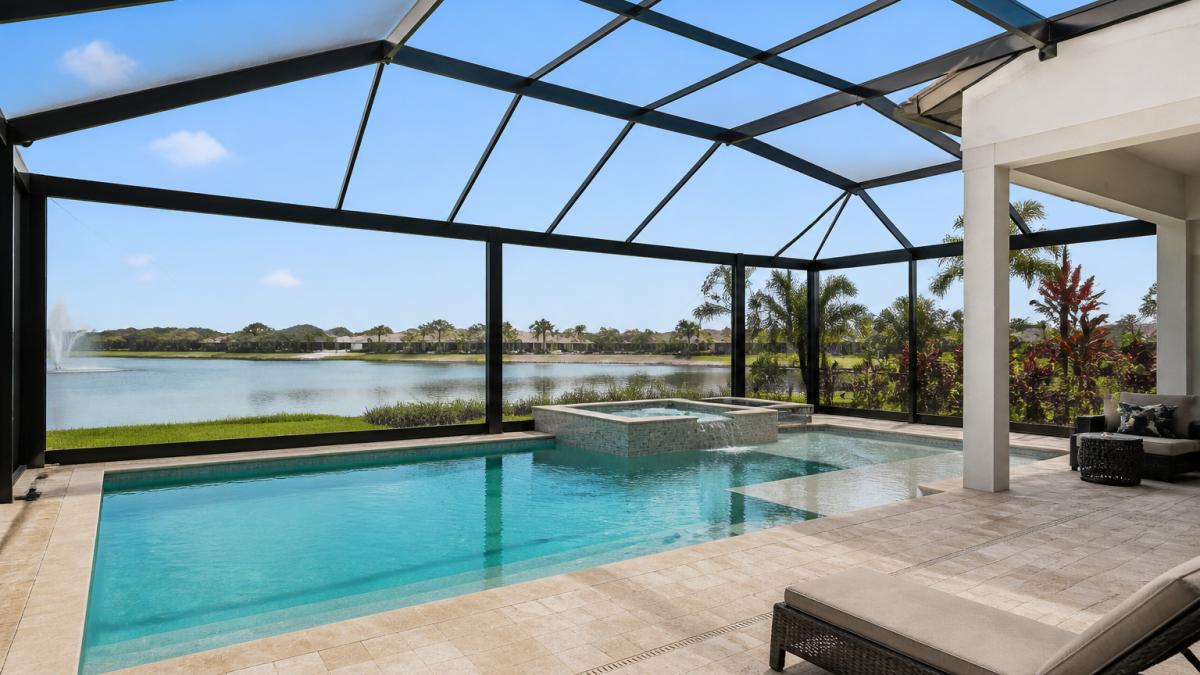
Picture Window Pool Cage Enclosures: Key Design Differences
Table of Contents
- Picture Window Pool Cage Enclosures: What Actually Changes
- How a Picture-Window Panel Differs From a Traditional Screen Panel
- Picture-Window vs Traditional Panels: Side-by-Side Design Comparison
- SMB Carrier Beam Pool Cage: How the Standard Frame Works
- Solid 4×8 Pool Cage Beam With Internal Corner Keys and Post Feet Inserts
- Pool Enclosure Storm Resistance: What the Framing Decides
- Mesh Choices, Visibility, and Long-Term Durability Trade-Offs
- Retrofit, Maintenance, and Storm-Damage Repair Considerations
- Conclusion: Choosing the Right Clear-View Design for Your Home
- Frequently Asked Questions
Last Updated: October 8, 2026
Picture Window Pool Cage Enclosures: What Actually Changes
A picture window pool cage screen enclosure replaces the small mesh panels above the chair rail with tall, wide spans of screen, so the structure provides an open, unobstructed view of your home’s exterior outdoor surroundings.
A picture window pool cage is an aluminum framed screen enclosure whose panels are oversized openings without a chair rail, often 8 feet or greater in width, framed by heavier aluminum members than a standard cage uses.
How a Picture-Window Panel Differs From a Traditional Screen Panel
A traditional pool cage screen panel is a small rectangle, typically 4-6 feet wide, held in a light aluminum frame with a mid-rail (chair rail) running horizontally across the enclosure typically at 24-36” off the deck.
The trade-off is load. A small panel sheds wind across a short span and transfers force into the frame at close intervals. A wide panel collects more pressure and delivers it to fewer, farther-apart connection points.
- Traditional panel: short span, mid-rail present, more framing members, smaller openings
- Picture-window panel: long span, mid-rail removed, fewer framing members, larger openings
- What changes underneath: beam depth, upright spacing, and how the frame is anchored
Picture-Window vs Traditional Panels: Side-by-Side Design Comparison
The clearest way to see the difference is to compare the two systems across the dimensions that decide performance: panel width, panel height, chair rail position, and framing.
|
Feature |
Traditional Screen Panel |
Picture-Window Panel |
|---|---|---|
|
Typical panel width |
4-7 ft |
8 ft or more |
|
Mid-rail |
chair height (24-36” off deck) |
Removed |
|
Chair rail position |
Standard height, continuous |
Omitted |
|
Framing members |
More, closely spaced |
Fewer, heavier |
|
Upright spacing |
Closer together |
Wider apart |
|
View quality |
Segmented by rails |
Unobstructed |
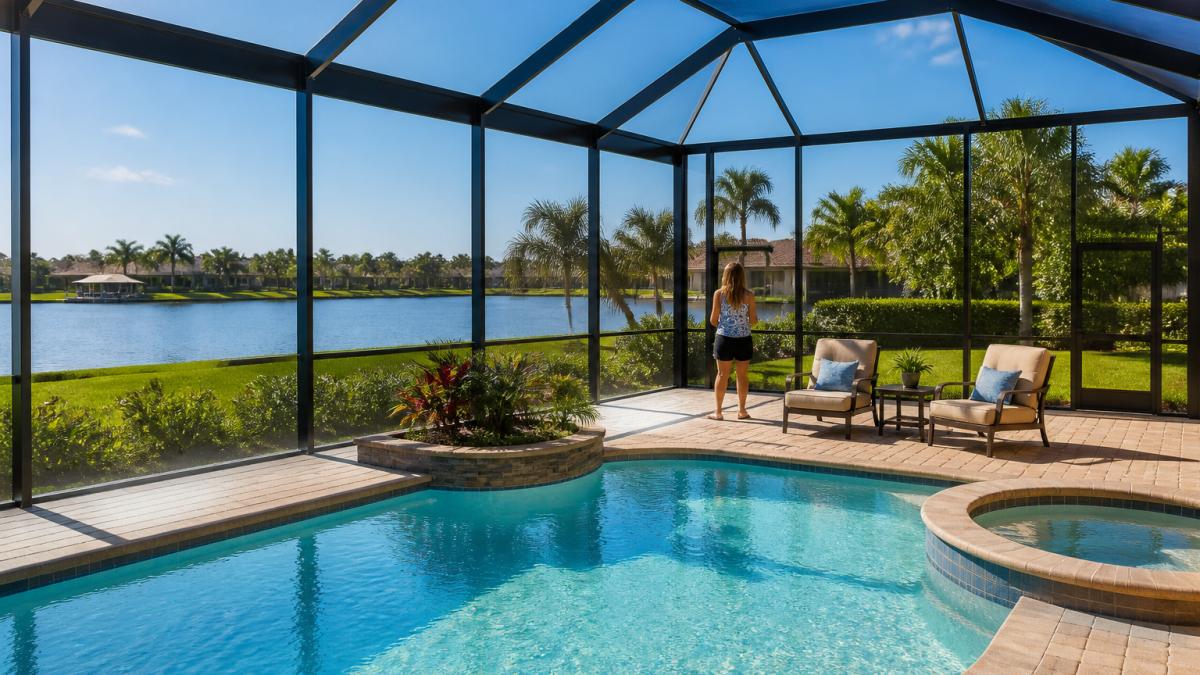
Traditional type pool cage in SW Florida with smaller spans and chair rail obstructing the view outside of the cage.
Panel Width, Height, and Where the Chair Rail Sits
The horizontal chair rail is the biggest visual difference. On a traditional cage it runs continuously at roughly chair-back height (24-36” off the deck), splitting every bay into a lower and upper panel; picture-window designs eliminate it on the view side.
That decision cascades. Removing the rail means the upper panel spans from the base to the roof beam, so the beam must be deeper and the uprights spaced to suit the wider bay.
SMB Carrier Beam Pool Cage: How the Standard Frame Works
An SMB carrier beam pool cage is a framing system in which a two-piece, aluminum member carries both the roof load and the screen panels.
The reason it works there is span.
Where the SMB carrier-beam approach runs into trouble is exactly where clear-view design pushes it.
A few practical consequences follow from that geometry:
- Deflection, not just stress, becomes the limit. A shallow beam can pass a stress check and still deflect enough that screen tension is lost, panels sag, and the spline works loose at the edges.
- Load concentrates at fewer points. With fewer uprights and no mid-rail, the same wind force arrives at fewer connections, so each corner and base connection sees more demand.
- The screen line and the structural line are the same line. There is no redundancy, if the carrier member distorts, the screen retention distorts with it.
None of this makes a SMB carrier-beam cage defective. It makes it a system with a defined envelope: small panels on short spans.
For readers who want to check the underlying mechanics rather than take a contractor’s word for it, the Aluminum Association publishes design references for aluminum structures, and the American Society of Civil Engineers publishes ASCE 7, the standard that defines how wind loads are determined for buildings and similar structures. Those are the same references a qualified engineer uses when sizing a beam for a given span and exposure. Aluminum Association design references for aluminum structures and ASCE 7 wind load standard overview are reasonable starting points for the vocabulary and the method.
Solid 4×8 Pool Cage Beam With Internal Corner Keys and Post Feet Inserts
A solid 4×8 pool cage beam is a heavier rectangular aluminum member, 4 inches by 8 inches in profile, joined at corners with internal keys and set onto posts with foot inserts. It is a structural beam first and a screen carrier second, and that order matters. Three things make it stronger than a carrier-beam approach: depth, since a 4×8 profile resists bending far better than a shallow carrier beam and deflects less under the same wind pressure; internal corner keys, which lock the beam ends together inside the joint, keeping the frame square under load and reducing the twisting that opens gaps at corners; and post feet inserts, which tie the upright to its base connection so load travels from the beam into the post and then into the deck.
We build our clear-view enclosures on this heavier system for that reason. You can see how we approach it on our aluminum screen enclosure engineering resources reference material and in our own project work.
Pool Enclosure Storm Resistance: What the Framing Decides
Pool enclosure storm resistance comes down to the load path, not the mesh. A cage fails when wind pressure on a wide panel finds a connection that cannot carry it, and the frame twists, racks, or pulls loose at the base.
The framing decides four things, and each one maps to a specific part of the structure:
- How much the beam deflects under pressure. Deflection lets panels lose tension and pop out of the spline. A deeper beam holds the screen line flatter under the same wind pressure.
- How well corners hold square. A cage that racks out of alignment opens gaps at the joints, and once a joint opens, water and wind get behind the frame and corrosion accelerates.
- How the load reaches the ground. Every pound of wind pressure has to travel from the screen, into the beam, down the upright, through the base connection, and into the deck. If any link is undersized, that is where failure starts.
- How much redundancy exists. Fewer, heavier members concentrate load; more, lighter members distribute it. Clear-view design deliberately reduces member count, so each remaining member has to be stronger.
Why the 4×8 Clearview System Is a Different Structural Class
A solid 4×8 pool cage beam is a heavier rectangular aluminum member, 4 inches by 8 inches in profile, joined at corners with internal corner keys and set onto posts with foot inserts bolted to the deck. It is a structural beam first and a screen carrier second. Depth is the single largest contributor to storm performance: a 4×8 profile resists bending far better than a shallow carrier beam, so it deflects less, keeps panels tensioned, and keeps the screen line true.
How to Validate the Claim Yourself
Any structural claim about a pool cage should be checkable, not just asserted. Three things make it checkable:
- The beam profile. Ask for the actual dimensions and the engineering plans of a picture window framed enclosure. A 4×8 profile is a specific, measurable thing; “heavy-duty” is not.
- The connection details. Ask how corners are joined and how the post attaches to the deck. Internal keys and foot inserts are describable, inspectable features.
- The design basis. Ask what wind speed and exposure the design was checked against. ASCE 7 is the standard reference for determining wind loads on structures, and the Aluminum Association publishes design references for aluminum members. A contractor who can point to those references is working from a method; one who cannot is working from habit. ASCE 7 wind load standard overview and Aluminum Association design references for aluminum structures are the places to start.
We build our clear-view enclosures on the solid 4×8 beam system with internal corner keys and post feet inserts for exactly these reasons. You can see how we approach the engineering side on our aluminum screen enclosure engineering resources reference material and in our own project work.
Mesh Choices, Visibility, and Long-Term Durability Trade-Offs
Mesh selection is a visibility-versus-strength decision, separate from the framing question. The frame carries the wind; the mesh resists impact, insects, and sun.
- Fiberglass mesh: the common choice, resists corrosion well in salt air, softer feel, moderate strength
- Polyester screen: tighter weave options, better for small insects, generally stronger than standard fiberglass
- High-strength screening: heavier denier for impact resistance, used where debris and pests are a real concern
Screen tension is the variable most homeowners never think about. A wide panel with poor tension sags and stretches, and a sagging panel catches more wind and fails sooner. On a picture-window cage, tension matters more because there is no mid-rail to break the span.
Retrofit, Maintenance, and Storm-Damage Repair Considerations
Retrofitting a traditional cage to a picture-window look is sometimes possible and often not worth it, because the beam and uprights were sized for the panels they already hold.
What usually makes sense instead:
- Full re-screen when the frame is sound and only the screen has aged, a pool cage screen repair or screen replacement
- Pool cage makeover when the frame is solid but the finish and fasteners have failed, which includes new stainless-steel fasteners, Sherwin-Williams DTM paint, and a complete re-screen
- Structural rebuild when the beams or base connections are compromised
Salt air and storm exposure accelerate corrosion at fasteners and base plates first, which is why those are the parts we replace rather than patch. If a storm has racked the frame, re-screening alone will not fix the geometry.
Conclusion: Choosing the Right Clear-View Design for Your Home
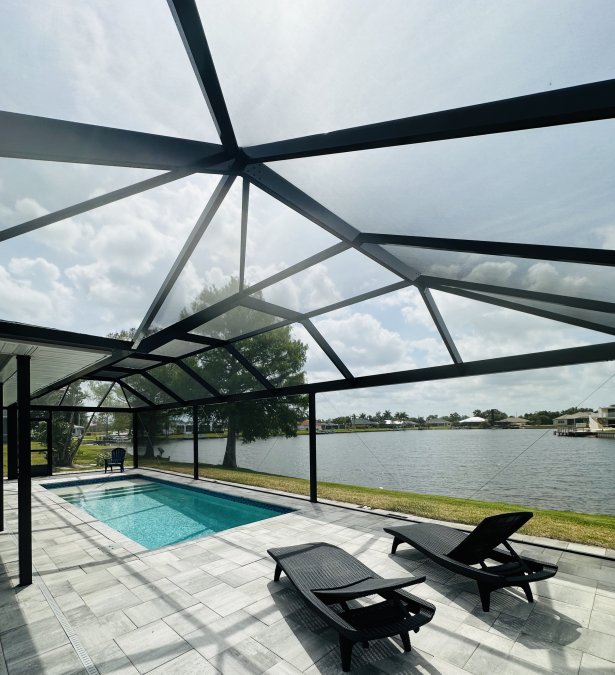
The design differences in a picture window pool cage come down to one question: was the frame engineered for wide panels, or adapted to them?
At My Hometown Screen Enclosure Pros, we build clear-view enclosures on the solid 4×8 beam system with internal corner keys and post feet inserts, backed by more than 30 years of construction experience and a limited lifetime warranty on new construction.
If you want a picture window pool cage design that holds up rather than one that just looks open, call us at (941) 621-3552 and we will walk you through what your enclosure actually needs.
We offer: rescreening services, pool cage screen repair, pool cage rescreening, lanai screen repair, patio screen repair, pet‑resistant screen repair, Punta Gorda pool screen repair, Charlotte County screen repair, Sarasota pool cage repair, North Port pool cage repair, pool cage restoration, hurricane damage repair, pool cage installation, lanai construction, picture window pool cage, picture‑window screen enclosure, picture‑window pool enclosure, panoramic screen enclosure, clear‑view pool enclosure, open‑view enclosure, mega‑view enclosure, and the best picture window pool cage design in Florida.
Frequently Asked Questions
What is a picture window pool cage, and how is it different from a traditional pool enclosure?
A picture window pool cage uses oversized screen panels, often spanning from the chair rail to the roof beam, instead of the smaller panels found on a traditional enclosure. Fewer horizontal and vertical framing members sit in your line of sight, so the view from the pool deck stays open. The trade-off is that larger panels need stronger framing and tighter screen tension to resist wind and sagging, which is why beam selection matters more on these designs.
Is a solid 4×8 beam stronger than an SMB carrier beam for a pool cage?
A solid 4×8 aluminum beam carries more load than a standard SMB carrier beam because it has a larger, solid cross-section rather than a thinner formed profile. When it is joined with internal corner keys and set on post feet inserts, the connections resist twisting and uplift better during high winds. Both systems are still pool cages, but the 4×8 Clearview frame is the more structurally sound choice for wide spans and storm-prone areas.
What type of screen mesh is best for a picture window pool cage?
For large picture-window panels, a high-strength screening material such as polyester or a heavier fiberglass mesh holds tension better than standard mesh and resists sagging over time. If no-see-ums are a problem, a finer mesh keeps them out, though it reduces airflow slightly. The right choice depends on how much wind exposure the enclosure gets and how important maximum airflow is to you.
Can an older pool cage be retrofitted with picture-window panels instead of a full rebuild?
Sometimes. The existing uprights, beams, and slab anchors have to be inspected first, because oversized panels add wind load that a tired frame may not handle. If the aluminum is sound and the support spacing is adequate, a retrofit is possible. If the frame is rusted or undersized, a rebuild with a solid 4×8 beam system is usually the safer path.
What services for you offer?
Rescreening services, pool cage screen repair, pool cage rescreening, lanai screen repair, patio screen repair, pet‑resistant screen repair, Punta Gorda pool screen repair, Charlotte County screen repair, Sarasota pool cage repair, North Port pool cage repair, pool cage restoration, hurricane damage repair, pool cage installation, lanai construction, picture window pool cage, picture‑window screen enclosure, picture‑window pool enclosure, panoramic screen enclosure, clear‑view pool enclosure, open‑view enclosure, mega‑view enclosure, and the best picture window pool cage design in Florida.